#01
Production Stack
At Sibiri Innovation, we build software engineered for high concurrency, zero technical debt, and mathematical reliability. Explore the verified technology stacks our senior practitioners use in active production — from MERN, MEAN, Next.js, and Enterprise Laravel 11 to Java Spring Boot, Python Django, MariaDB Galera clusters, and autonomous Agentic AI with LangGraph & RAG.
engine: "Sibiri Innovation Core Architecture"
tier_1_fullstack: [MERN, MEAN, Next.js 15, React 19]
tier_2_backend: [Laravel 11, PHP 8.3 JIT, Django 5, FastAPI]
tier_3_enterprise: [Java 21 Spring Boot, NestJS, Kafka]
tier_4_ai_agents: [Agentic AI, RAG, LangChain, LangGraph, LLM]
tier_5_storage_cms: [MariaDB Galera, Qdrant, Wikis, WordPress]
tier_6_cloud: [Kubernetes, Docker, Terraform, AWS]
Explore how we structure our technological competencies into distinct domain tiers for enterprise clients worldwide.
Modern interactive single-page applications, React Server Components (RSC), and Angular 18 Signals engineered for sub-second page loads and seamless cloud distribution.
High-concurrency business platforms, multi-tenant ERPs, and financial ledgers powered by Laravel Octane, JIT compilation, and native WebSockets.
Distributed microservice meshes built on Java 21 Virtual Threads and NestJS modular architectures with Kafka event streaming and circuit breakers.
Autonomous multi-agent swarms, cyclical state graphs, hybrid vector search (Qdrant), and production LLM inference pipelines with audit-proof verification.
Decoupled headless WordPress with Next.js frontends and Git-synchronized Open Source Wiki engines (Wiki.js, BookStack) for compliance and documentation.
Multi-master synchronous relational clusters, ProxySQL read-write splitting, Kubernetes container orchestration, and automated Terraform infrastructure.
In-depth architectural breakdowns of the 14 core technology stacks powering Sibiri Innovation's client solutions and internal platforms.
Enterprise Documentation, Markdown Runbooks & Knowledge Governance
At Sibiri Innovation, we implement, harden, and scale open-source wiki and knowledge base engines for organizations requiring sovereign data governance, team documentation, and developer runbooks. We architect high-performance deployments powered by Wiki.js, BookStack, MediaWiki, and Docusaurus — integrating full-text vector search, role-based access control (RBAC), single sign-on (SSO), and automated Git-backed versioning.
docker-compose.yml (Enterprise Wiki.js with PostgreSQL & Redis Cache)
version: '3.8'
services:
  wikijs:
    image: ghcr.io/requarks/wiki:2
    restart: unless-stopped
    environment:
      DB_TYPE: postgres
      DB_HOST: db
      DB_PORT: 5432
      DB_USER: wikijs
      DB_PASS: ${DB_PASSWORD}
      DB_NAME: wiki
      REDIS_URL: redis://cache:6379
    ports:
      - '3000:3000'
    depends_on:
      - db
      - cache
  db:
    image: postgres:16-alpine
    restart: unless-stopped
    volumes:
      - pgdata:/var/lib/postgresql/data
  cache:
image: redis:7-alpineDecoupled VIP WordPress Architectures with Next.js Frontends & GraphQL
We engineer enterprise-scale WordPress platforms that discard legacy monolith constraints. By decoupling the administrative editorial backend from modern Next.js or React frontends using WPGraphQL and REST APIs, our solutions deliver sub-100ms load times, uncompromised security, and publisher-friendly Gutenberg experiences that marketing teams love.
// Next.js 15 App Router: Fetching Headless WordPress Post via WPGraphQL
import { cache } from 'react';

export const getPost = cache(async (slug: string) => {
  const query = `
    query GetPostBySlug($slug: ID!) {
      post(id: $slug, idType: SLUG) {
        title
        content
        featuredImage { node { sourceUrl altText } }
        seo { title metaDesc schema { raw } }
      }
    }
  `;
  const res = await fetch(process.env.WORDPRESS_API_URL!, {
    method: 'POST',
    headers: { 'Content-Type': 'application/json' },
    body: JSON.stringify({ query, variables: { slug } }),
    next: { revalidate: 3600, tags: [`post-${slug}`] } // Instant ISR revalidation
  });
  const { data } = await res.json();
  return data?.post;
});Enterprise SaaS, High-Concurrency Web Applications & Event-Driven Systems
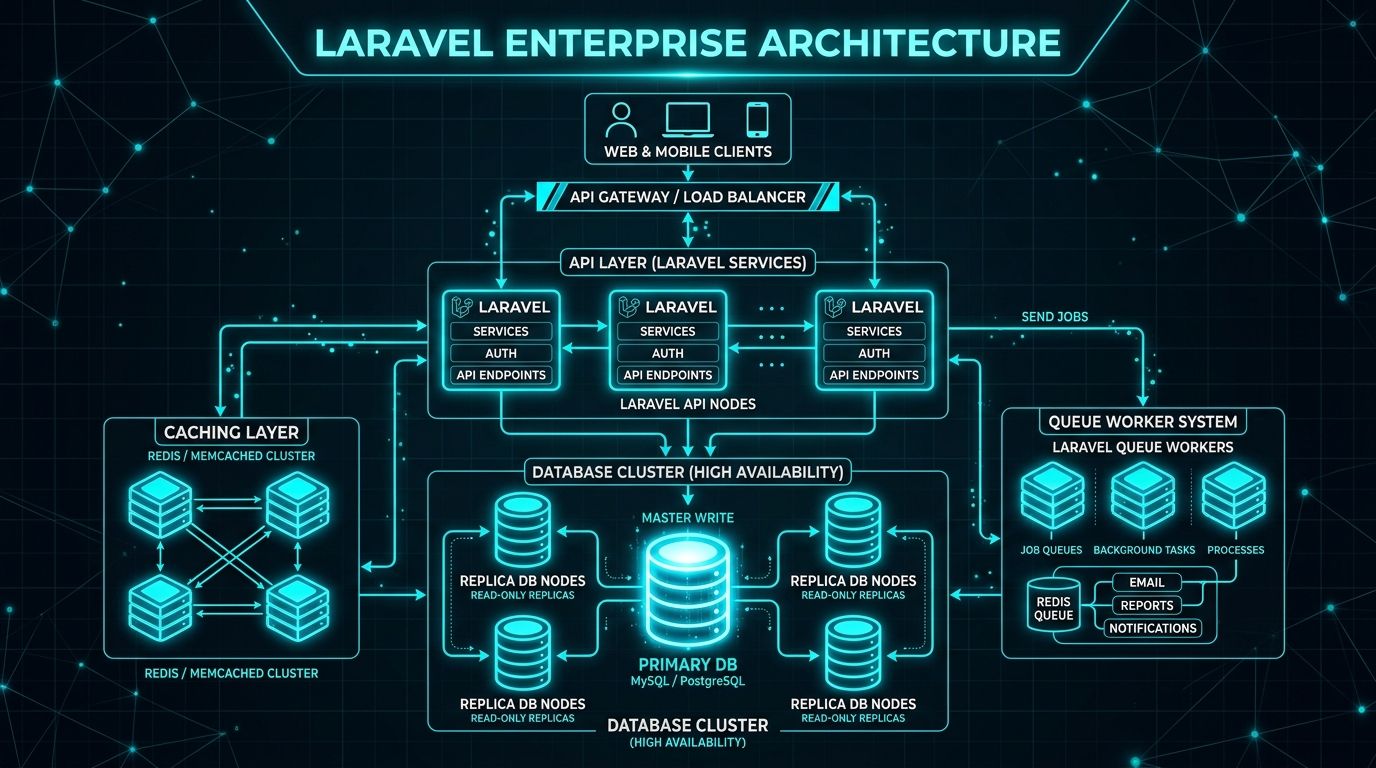
Sibiri Innovation treats Laravel 11 as a premier enterprise engineering platform. We leverage Laravel Octane (FrankenPHP/Swoole), Horizon background workers, Livewire, and Redis clustering to deliver robust multi-tenant architectures, financial ledgers, and distributed systems handling millions of daily requests with mathematical reliability.
<?php
namespace App\Services;

use App\Repositories\Contracts\OrderRepositoryInterface;
use App\Events\OrderProcessed;
use Illuminate\Support\Facades\DB;
use Illuminate\Support\Facades\Cache;

class EnterpriseOrderService
{
    public function __construct(protected OrderRepositoryInterface $orders) {}

    public function processOrder(array $payload): Order
    {
        return DB::transaction(function () use ($payload) {
            $order = $this->orders->createWithLock($payload);
            Cache::tags(['analytics', 'financials'])->flush();
            event(new OrderProcessed($order));
            return $order;
        }, attempts: 5);
    }
}High-Throughput Micro-Engines, Custom Composer Packages & Standalone Daemons
Beyond full frameworks, our engineering teams build specialized, ultra-lightweight micro-services and custom Composer packages using modern PHP 8.3+. Taking full advantage of JIT (Just-In-Time) compilation, strict typed properties, Readonly classes, and Fibers for asynchronous I/O, we achieve raw execution speeds competitive with Go and Java.
<?php
declare(strict_types=1);

namespace Sibiri\Core\Engine;

readonly class TransactionPayload
{
    public function __construct(
        public string $transactionId,
        public float $amount,
        public string $currency,
        public \DateTimeImmutable $timestamp
    ) {}

    public function validate(): bool
    {
        return $this->amount > 0 && strlen($this->currency) === 3;
    }
}Reactive Full-Stack JavaScript with MongoDB, Express, React 19 & Node.js
Our MERN stack practice delivers dynamic, highly reactive web applications with seamless JSON data continuity across client and server. By combining MongoDB Atlas sharded clusters, modular Express/Node backends, and React 19 concurrent rendering, we construct interactive single-page applications engineered for enterprise user loads.
// Express.js High-Throughput Aggregation Pipeline
import express from 'express';
import { MetricsModel } from '../models/Metrics';

export const router = express.Router();

router.get('/analytics/summary', async (req, res, next) => {
  try {
    const data = await MetricsModel.aggregate([
      { $match: { tenantId: req.tenant.id, createdAt: { $gte: new Date(Date.now() - 86400000) } } },
      { $group: { _id: '$eventType', count: { $sum: 1 }, avgDuration: { $avg: '$durationMs' } } },
      { $sort: { count: -1 } }
    ]).hint({ tenantId: 1, createdAt: -1 });

    return res.json({ success: true, data });
  } catch (err) {
    next(err);
  }
});GPT-4o, Claude 3.5, Llama 3, Local Model Fine-Tuning & Enterprise Prompt Pipelines
We architect production-grade Generative AI solutions leveraging leading frontier models (OpenAI GPT-4o, Anthropic Claude 3.5 Sonnet) as well as open-source private models (Llama 3, Mistral, DeepSeek). We implement structured output guarantees, guardrails against hallucinations, and token cost optimization.
# Pydantic Structured Output Enforcement with Instructor
from pydantic import BaseModel, Field
import instructor
from openai import OpenAI

class EnterpriseContractSummary(BaseModel):
    client_name: str = Field(description="Party signing the contract")
    total_value_usd: float = Field(description="Total monetary value")
    sla_percentage: float = Field(description="Service level agreement guaranteed")

client = instructor.from_openai(OpenAI())
response = client.chat.completions.create(
    model="gpt-4o",
    response_model=EnterpriseContractSummary,
    messages=[{"role": "user", "content": raw_contract_text}]
)Type-Safe Enterprise JavaScript with MongoDB, Express, Angular 18+ & Node.js
For enterprise applications requiring strict architectural conventions, declarative reactive programming, and large development teams, we deploy the MEAN stack. Leveraging Angular 18+ Signals, RxJS observable streams, and modular Node.js architectures, we deliver structured software that stands up to multi-year enterprise lifecycles.
// Angular 18 Signal-Based Service with Reactive Stream
import { Injectable, signal, computed, inject } from '@angular/core';
import { HttpClient } from '@angular/common/http';

export interface TelemetryMetric { id: string; status: 'healthy' | 'critical'; latencyMs: number; }

@Injectable({ providedIn: 'root' })
export class SystemTelemetryService {
  private http = inject(HttpClient);
  private _metrics = signal<TelemetryMetric[]>([]);

  readonly metrics = this._metrics.asReadonly();
  readonly criticalCount = computed(() => this._metrics().filter(m => m.status === 'critical').length);

  fetchTelemetry(): void {
    this.http.get<TelemetryMetric[]>('/api/telemetry/nodes')
      .subscribe(data => this._metrics.set(data));
  }
}Asynchronous REST/GraphQL APIs, Data Pipelines & Rapid AI Microservice Integration
Our Python practice bridges modern web engineering with machine learning and computational workflows. We deploy Django 5 for batteries-included administrative platforms, and FastAPI for high-throughput asynchronous microservices, data ingestion engines, and low-latency AI inference gateways.
# FastAPI Asynchronous Microservice Endpoint with Pydantic v2
from fastapi import FastAPI, BackgroundTasks, Depends, HTTPException
from pydantic import BaseModel, Field
import uvicorn

app = FastAPI(title="Sibiri Inference API", version="2.4.0")

class InferenceRequest(BaseModel):
    document_id: str
    query: str = Field(..., min_length=3)
    temperature: float = Field(default=0.2, ge=0.0, le=1.0)

@app.post("/api/v1/predict")
async def generate_prediction(req: InferenceRequest, bg: BackgroundTasks):
    # Asynchronous non-blocking AI pipeline
    bg.add_task(log_telemetry_async, req.document_id)
    result = await execute_rag_pipeline(req.document_id, req.query, req.temperature)
return {"status": "success", "payload": result}Vector Databases, Semantic Search & Enterprise Knowledge Grounding
Our RAG (Retrieval-Augmented Generation) systems connect LLMs to your company private databases, PDFs, ERP records, and internal wikis with zero hallucinations. We build hybrid vector + keyword search pipelines with contextual re-ranking and sub-second retrieval latency.
# Two-Stage Hybrid Vector Search with Re-Ranking
from qdrant_client import QdrantClient
import cohere

qdrant = QdrantClient(url="https://vector.sibiri.internal")
co = cohere.Client("cohere-key")

async def retrieve_grounded_context(query: str):
    # Step 1: Hybrid Vector + Keyword Retrieval
    candidates = qdrant.query(collection_name="enterprise_docs", query_text=query, limit=25)

    # Step 2: Cross-Encoder Re-Ranking
    reranked = co.rerank(model="rerank-english-v3.0", query=query, documents=[c.payload["text"] for c in candidates], top_n=4)
return [r.document.text for r in reranked.results]High-Throughput Distributed Microservices, Event Streaming & Fault-Tolerant Enterprise Systems
For mission-critical banking, telecom, and high-concurrency enterprise ecosystems, Sibiri Innovation relies on Java 21 LTS and Spring Boot 3.3. Leveraging Project Loom Virtual Threads, Apache Kafka event streams, and Spring Cloud, we build fault-tolerant microservices that process millions of transactions with strict ACID compliance.
// Spring Boot 3.3 Virtual Thread Enabled Service
package com.sibiri.enterprise.service;

import org.springframework.stereotype.Service;
import org.springframework.transaction.annotation.Transactional;
import org.springframework.kafka.core.KafkaTemplate;
import io.github.resilience4j.circuitbreaker.annotation.CircuitBreaker;

@Service
public class EnterprisePaymentService {
    private final KafkaTemplate<String, Object> kafkaTemplate;

    public EnterprisePaymentService(KafkaTemplate<String, Object> kafkaTemplate) {
        this.kafkaTemplate = kafkaTemplate;
    }

    @Transactional
    @CircuitBreaker(name = "paymentGateway", fallbackMethod = "handleGatewayFallback")
    public PaymentReceipt processPayment(PaymentCommand cmd) {
        // High-throughput virtual-thread transaction
        kafkaTemplate.send("payment-events", cmd.transactionId(), cmd);
        return new PaymentReceipt(cmd.transactionId(), "PROCESSED");
    }
}Composable LLM Chains, Document Loaders & Tool Integrations
LangChain provides the foundational orchestration layer for chaining LLM calls with external data loaders, memory buffers, and tool calling interfaces. We implement production-ready LangChain pipelines with structured LCEL (LangChain Expression Language) for maximum modularity and testability.
# Production LCEL Chain with Vector Retrieval & Streaming Output
from langchain_core.prompts import ChatPromptTemplate
from langchain_core.output_parsers import StrOutputParser
from langchain_core.runnables import RunnablePassthrough
from langchain_openai import ChatOpenAI

prompt = ChatPromptTemplate.from_template("""Answer based strictly on the context:
{context}
Question: {question}""")

rag_chain = (
    {"context": retriever | format_docs, "question": RunnablePassthrough()}
    | prompt
    | ChatOpenAI(model="gpt-4o", temperature=0.1)
    | StrOutputParser()
)Stateful Multi-Agent Cyclic Graphs & Human-in-the-Loop Decisions
LangGraph is our standard architecture for building complex, multi-agent AI workflows that require loops, state persistence, conditional branching, and human approval checkpoints. Unlike simple linear chains, LangGraph allows autonomous agents to reflect, correct errors, and collaborate over shared state graphs.
# LangGraph Multi-Agent State Machine with Reflection Loop
from langgraph.graph import StateGraph, END
from typing import TypedDict, Annotated

class AgentState(TypedDict):
    task: str
    draft_code: str
    review_passed: bool
    iterations: int

builder = StateGraph(AgentState)
builder.add_node("developer", write_code_node)
builder.add_node("reviewer", review_code_node)
builder.add_edge("developer", "reviewer")

builder.add_conditional_edges(
    "reviewer",
    lambda s: END if s["review_passed"] or s["iterations"] >= 3 else "developer"
)
builder.set_entry_point("developer")
graph = builder.compile()Enterprise React Architecture with Hybrid SSR, App Router & Edge Runtime Performance
Sibiri Innovation builds consumer-facing and corporate web flagships using Next.js 15 and the React Server Components (RSC) App Router. Combining server-side rendering (SSR), Incremental Static Regeneration (ISR), and edge caching, we deliver Google Lighthouse 95+ performance scores and instantaneous page loads worldwide.
// Next.js 15 App Router: Server Component with Streaming Suspense
import { Suspense } from 'react';
import { ArchitectureBlueprintList } from '@/components/blueprints';
import { SkeletonLoader } from '@/components/ui';

export const revalidate = 1800; // Revalidate cache every 30 minutes

export default async function ArchitectureHubPage() {
  return (
    <main className="container mx-auto px-6 py-12">
      <header className="mb-8">
        <h1 className="text-4xl font-bold tracking-tight">Production Blueprints</h1>
        <p className="text-gray-400">Verified engineering architectures deployed in enterprise production.</p>
      </header>
      <Suspense fallback={<SkeletonLoader count={6} />}>
        <ArchitectureBlueprintList />
      </Suspense>
    </main>
  );
}Autonomous Task Execution, Tool Calling & Collaborative AI Fleets
Agentic AI represents the highest tier of intelligent systems: autonomous AI agents that reason, plan sub-tasks, execute tools (API calls, shell commands, database queries), observe feedback, and self-heal errors until the objective is achieved. We build specialized multi-agent fleets with CrewAI and AutoGen.
# CrewAI Multi-Agent Task Orchestration
from crewai import Agent, Task, Crew, Process

architect = Agent(
    role="Enterprise Software Architect",
    goal="Design scalable cloud architectures for incoming client requirements",
    backstory="Senior software architect with 15+ years in high-concurrency cloud systems",
    tools=[cloud_pricing_tool, benchmark_tool],
    verbose=True
)

qa_engineer = Agent(
    role="Security & Resilience Auditor",
    goal="Audit architecture designs against OWASP top 10 and cloud resilience standards",
    backstory="Strict cybersecurity auditor focused on zero-trust and data privacy",
    verbose=True
)

crew = Crew(
    agents=[architect, qa_engineer],
    tasks=[design_task, audit_task],
    process=Process.sequential
)
result = crew.kickoff()Scalable, Modular Node.js Microservices Engineered with Strict Dependency Injection
When organizations need the speed and ecosystem of Node.js combined with the architectural discipline of enterprise Java/Angular, we build on NestJS. Utilizing TypeScript, decorators, dependency injection, and native microservice transports, we engineer clean backends that easily scale across multiple engineering squads.
// NestJS Modular Controller with Dependency Injection & DTO Validation
import { Controller, Post, Body, UseGuards, UsePipes, ValidationPipe } from '@nestjs/common';
import { JwtAuthGuard } from '../auth/jwt.guard';
import { CreateTelemetryDto } from './dto/telemetry.dto';
import { TelemetryService } from './telemetry.service';

@Controller('v1/telemetry')
@UseGuards(JwtAuthGuard)
export class TelemetryController {
  constructor(private readonly telemetryService: TelemetryService) {}

  @Post('ingest')
  @UsePipes(new ValidationPipe({ whitelist: true, transform: true }))
  async ingest(@Body() dto: CreateTelemetryDto) {
    return this.telemetryService.processMetricBatch(dto);
  }
}Predictive Analytics, Computer Vision, Deep Learning & Enterprise Data Pipelines
Sibiri Innovation designs and deploys custom machine learning models tailored to operational business challenges. From convolutional computer vision networks to time-series predictive algorithms and natural language processing pipelines, our data science teams convert raw enterprise data into automated intelligence.
# PyTorch Inference Pipeline with ONNX Runtime Acceleration
import onnxruntime as ort
import numpy as np

class OptimizedInferenceEngine:
    def __init__(self, model_path: str):
        self.session = ort.InferenceSession(
            model_path,
            providers=['CUDAExecutionProvider', 'CPUExecutionProvider']
        )
        self.input_name = self.session.get_inputs()[0].name

    def predict(self, feature_vector: np.ndarray) -> dict:
        inputs = {self.input_name: feature_vector.astype(np.float32)}
        raw_outputs = self.session.run(None, inputs)
        probabilities = np.exp(raw_outputs[0]) / np.sum(np.exp(raw_outputs[0]))
return {'predicted_class': int(np.argmax(probabilities)), 'confidence': float(np.max(probabilities))}Autonomous Multi-Agent Fleets, Cyclic State Machines, Qdrant Vector Search & Enterprise LLMs
We engineer the vanguard of enterprise AI: moving beyond simple chatbots into autonomous, multi-agent systems and verifiable Retrieval-Augmented Generation (RAG). Utilizing LangChain, LangGraph state machines, Qdrant vector databases, and models like GPT-4o and Claude 3.5 Sonnet, our systems reason, execute multi-step workflows, verify facts against company documentation, and run autonomous business operations.
# LangGraph Multi-Agent Cyclic State Machine
from langgraph.graph import StateGraph, END
from typing import TypedDict, Annotated
import operator

class AgentWorkflowState(TypedDict):
    query: str
    retrieved_docs: list[str]
    draft_response: str
    critique: str
    iteration: int

def retrieve_node(state: AgentWorkflowState):
    docs = qdrant_hybrid_search(state['query'], top_k=5)
    return {'retrieved_docs': docs}

def generate_node(state: AgentWorkflowState):
    draft = llm_synthesize(state['query'], state['retrieved_docs'])
    return {'draft_response': draft, 'iteration': state.get('iteration', 0) + 1}

def critique_node(state: AgentWorkflowState):
    verdict = llm_verify_facts(state['draft_response'], state['retrieved_docs'])
    return {'critique': verdict}

workflow = StateGraph(AgentWorkflowState)
workflow.add_node('retrieve', retrieve_node)
workflow.add_node('generate', generate_node)
workflow.add_node('critique', critique_node)
workflow.set_entry_point('retrieve')
workflow.add_edge('retrieve', 'generate')
workflow.add_edge('generate', 'critique')
workflow.add_conditional_edges('critique', lambda s: END if s['critique'] == 'PASS' or s['iteration'] > 3 else 'generate')
agent_app = workflow.compile()High-Availability Galera Clusters, ACID Storage Engines & Sub-Millisecond Query Optimization
MariaDB and MySQL form the high-availability relational foundation of our enterprise business solutions. We architect multi-master Galera Clusters, master-slave read replicas with ProxySQL, automated point-in-time recovery, and optimized schema partitioning to ensure zero data loss and sub-2ms query response times under high-concurrency loads.
-- MariaDB High-Performance Partitioned Table Schema
CREATE TABLE enterprise_ledger_transactions (
    transaction_id BIGINT UNSIGNED NOT NULL AUTO_INCREMENT,
    tenant_id INT UNSIGNED NOT NULL,
    account_number VARCHAR(34) NOT NULL,
    amount DECIMAL(18, 4) NOT NULL,
    currency CHAR(3) NOT NULL,
    status ENUM('PENDING', 'SETTLED', 'FAILED') NOT NULL DEFAULT 'PENDING',
    created_at TIMESTAMP NOT NULL DEFAULT CURRENT_TIMESTAMP,
    PRIMARY KEY (transaction_id, created_at),
    KEY idx_tenant_status (tenant_id, status),
    KEY idx_account_date (account_number, created_at)
) ENGINE=InnoDB ROW_FORMAT=COMPRESSED
PARTITION BY RANGE (UNIX_TIMESTAMP(created_at)) (
    PARTITION p_2026_q1 VALUES LESS THAN (UNIX_TIMESTAMP('2026-04-01 00:00:00')),
    PARTITION p_2026_q2 VALUES LESS THAN (UNIX_TIMESTAMP('2026-07-01 00:00:00')),
    PARTITION p_2026_q3 VALUES LESS THAN (UNIX_TIMESTAMP('2026-10-01 00:00:00')),
    PARTITION p_future  VALUES LESS THAN MAXVALUE
);Zero-Downtime CI/CD Pipelines, Kubernetes Orchestration & Infrastructure as Code
Our Cloud & DevOps engineering practice guarantees continuous integration, automated testing, and zero-downtime rolling deployments. We manage production Kubernetes clusters, Docker container registries, Terraform infrastructure-as-code, and Prometheus/Grafana observability suites across AWS, GCP, and bare-metal environments.
# Kubernetes Production Deployment with Rolling Updates & Health Checks
apiVersion: apps/v1
kind: Deployment
metadata:
  name: sibiri-core-api
  namespace: production
spec:
  replicas: 5
  strategy:
    type: RollingUpdate
    rollingUpdate:
      maxSurge: 1
      maxUnavailable: 0
  template:
    spec:
      containers:
      - name: api
        image: 123456789.dkr.ecr.us-east-1.amazonaws.com/sibiri-api:v2.4.1
        ports:
        - containerPort: 8000
        resources:
          limits: { cpu: '1000m', memory: '1024Mi' }
          requests: { cpu: '250m', memory: '256Mi' }
        readinessProbe:
          httpGet: { path: /health/ready, port: 8000 }
          initialDelaySeconds: 5
periodSeconds: 10A transparent comparison of concurrency models, data layers, and best-fit business use cases across our production technology stacks.
| Technology Stack | Primary Focus | Concurrency Model | Database & Data Layer | Ideal Project Type |
|---|---|---|---|---|
| Open Source Wikis | Knowledge Governance & SOPs | Decoupled Git Sync & Node.js | PostgreSQL / SQLite / Vector Search | Internal runbooks, API documentation, compliance portals |
| Enterprise WordPress | Headless Publishing & VIP Media | Decoupled ISR via Next.js | MariaDB + Redis Persistent Cache | High-traffic editorial sites, corporate flagships, marketing hubs |
| PHP with Laravel 11 | Enterprise SaaS & ERP Platforms | Multi-Process with Octane & Redis | MySQL / PostgreSQL / Eloquent ORM | Complex business workflows, ERPs, accounting ledgers, B2B SaaS |
| Modern Core PHP 8.3 | High-Throughput Micro-Engines | JIT Compiler + Native Fibers Async | Raw PDO / Specialized In-Memory | Payment gateways, telemetry parsers, standalone Composer SDKs |
| MERN Stack | Real-Time SPAs & Interactive Web | Async Single-Threaded Event Loop | MongoDB Atlas (NoSQL Document Store) | Real-time collaboration, dashboards, customer self-service |
| MEAN Stack | Type-Safe Enterprise Workflows | Angular 18 Signals + Express | MongoDB / Enterprise Data Stores | Banking portals, clinical healthcare workflows, telecom consoles |
| Next.js 15 & RSC | Hybrid SSR & Edge Flagships | Edge Runtime + React Server Components | REST / GraphQL / Edge Caching | High-conversion e-commerce, global marketing platforms |
| NestJS Enterprise | Modular TypeScript Microservices | Event-Driven + Dependency Injection | Prisma / TypeORM / Kafka / Redis | Fintech platforms, IoT backends, code-first GraphQL meshes |
| Python Django & FastAPI | Async APIs & AI Microservices | ASGI Async / Distributed Celery | PostgreSQL / SQLAlchemy / Vector DBs | AI model serving endpoints, data engineering, fast REST APIs |
| Java with Spring Boot | High-Throughput Distributed Systems | Multi-Threaded JVM + Virtual Threads | PostgreSQL / Oracle / Kafka / JPA | Core banking engines, transaction gateways, telecom backbones |
| AI & Machine Learning | Predictive Analytics & Vision | GPU Tensor Pipelines & ONNX | Feature Stores & S3 Lakehouses | Automated OCR, fraud detection, predictive maintenance, demand forecast |
| Agentic AI & LangGraph | Autonomous Workflows & RAG | Stateful Cyclical Graphs & Checkpoints | Qdrant Vector DB + Context Windows | Autonomous multi-agent research, audit-proof document search |
| MariaDB Galera Clusters | Zero-Data-Loss ACID Transactions | Multi-Master Synchronous Replication | InnoDB Storage Engine + ColumnStore | Mission-critical financial ledgers, transactional databases |
| DevOps & Cloud (K8s) | Zero-Downtime Infrastructure | Container Orchestration & Auto-Scaling | Managed Cloud DBs / Redis Clusters | High-availability production clusters, GitOps, CI/CD pipelines |
Read real-world architecture case studies, benchmarks, and production retrospectives.
Choosing an undergraduate subject after Class 12 is one of the most consequential academic decisions in a student's life. This guide helps students and parents understand which UG subjects best align with different Class 12 backgrounds, learning styles, and academic strengths.
From Marine Biology and Tea Management to Puppetry and Ethnobotany — discover some of India's most unique and specialized undergraduate courses that offer rewarding careers in niche fields.
Artificial Intelligence is transforming every industry. Mastering AI skills — from machine learning and data handling to ethics and programming — opens doors to exciting careers and empowers innovation.
Select your technology track, service requirements, or submit a project registration inquiry.